Mental Performance · June 2026
The stress container. A simple idea that changes the conversation.
Most people know they're under pressure. Few know how to talk about it, with themselves or with others.
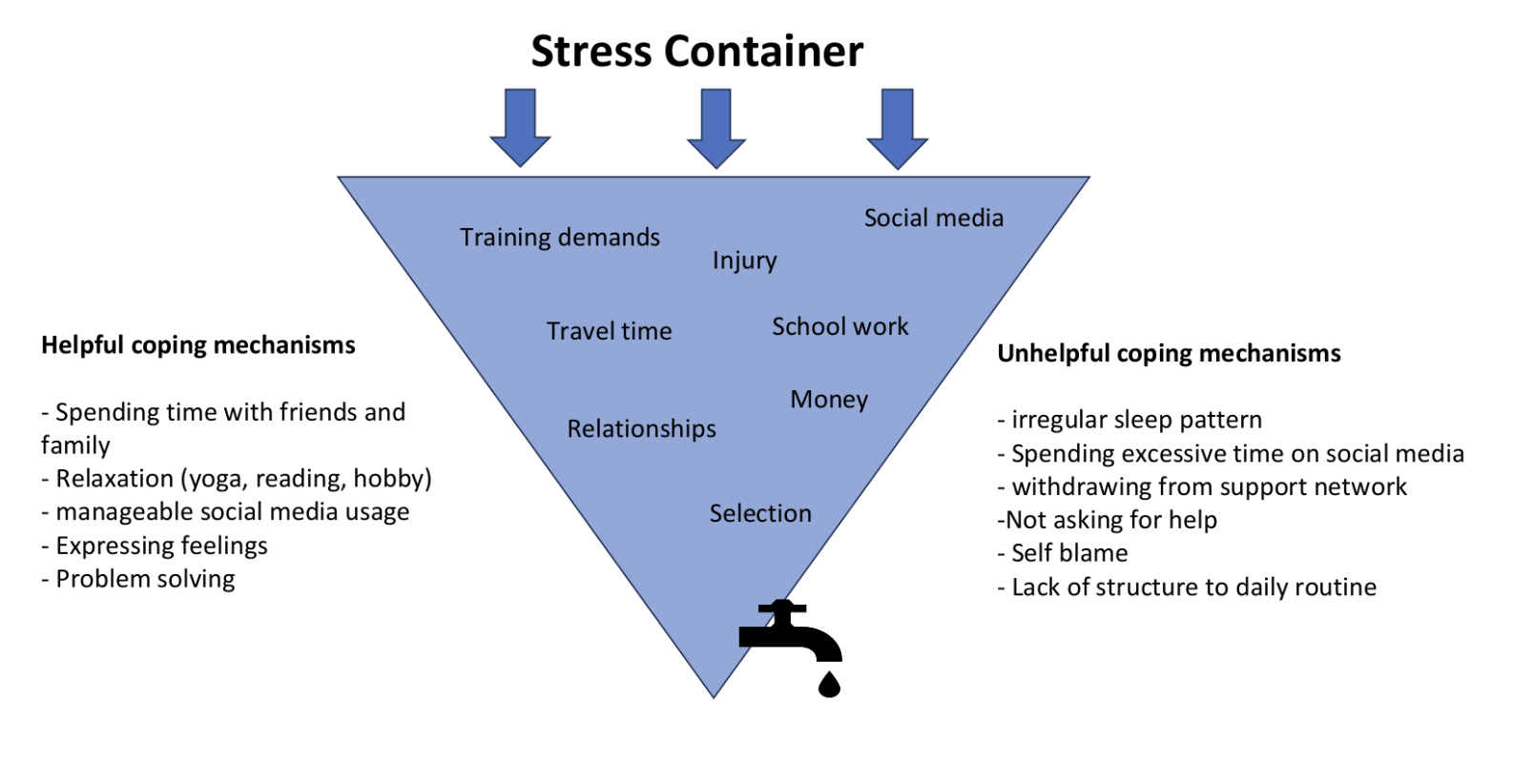
I came across this concept recently, in an article by Jane Holden, published on parentsinsport.co.uk. It gives clarity, not because it is a new idea, but because it names something in a way that makes it immediately accessible to anyone.
The idea is simple. We each carry a container. Life fills it. Work, expectations, relationships, performance, uncertainty. The container has a tap, our coping mechanisms, the things that help us release pressure before it overflows. And when the tap isn't working, or the container fills faster than we can empty it, we overflow. That's when we see the signs, in our behaviour, our emotions, our body.
What this means in practice
In my work as a coach and mentor, I rarely meet people who don't know they're under pressure. What they often don't have is a way to talk about it, with themselves, or with the people around them.
The stress container gives you that language.
It works for executives who need to understand why they snap at their team on a Tuesday. It works for athletes who perform brilliantly in training and freeze in competition. It works for parents trying to support a child through pressure they can barely manage themselves.
And that last point matters. When someone else's container overflows, it doesn't stay contained to them. Stress pours into the people closest to them. The parent who is anxious about their child's performance. The leader whose team absorbs their tension. The partner who carries what isn't theirs to carry.
The oxygen mask principle
There's a reason the safety instructions on a plane tell you to put your own mask on first. You cannot effectively support someone else from a depleted state. This is not selfishness. It is a precondition for being useful.
The most important question the stress container raises is not "how full is yours?" It's: "what does your tap look like, and is it actually working?"
In my experience, the people who navigate pressure best are not the ones who feel less of it. They are the ones who know their container, know their tap, and have learned, often the hard way, when to ask for help before the overflow begins.
Inspired by an article by Jane Holden, published on parentsinsport.co.uk
Still learning. Still moving forward.
What fills your container? And what helps you release the pressure? I'd like to hear.
Get in touch